

Provocholine® for Methacholine Challenge Testing
Provocholine® (methacholine chloride) is FDA-approved and is used as a methacholine challenge test to help evaluate airway hyperresponsiveness in patients 5 years of age and older. Available as both a powder formulation and a ready-to-use solution.
Provocholine® for Methacholine Challenge Testing
Provocholine® (methacholine chloride) is FDA-approved and is used as a methacholine challenge test to help evaluate airway hyperresponsiveness in patients 5 years of age and older. Available as both a powder formulation and a ready-to-use solution.
Why Perform Methacholine Challenge Testing for Asthma Diagnosis?
Methacholine challenge testing is used to evaluate airway hyperresponsiveness and can help support the diagnosis of asthma when spirometry results are normal or inconclusive. Provocholine® is used as part of a standardized methacholine challenge test performed under the supervision of trained healthcare professionals.

Supports Asthma Diagnosis
Objective testing when asthma is suspected but baseline spirometry is inconclusive.

Evaluates Airway Hyperresponsiveness
Measures airway responsiveness to assist in the clinical assessment of asthma.

Guideline-Supported Testing
Methacholine challenge testing is recognized in established respiratory guidelines and should be performed using standardized protocols.

Patients 5 Years of Age and Older
Approved for use in patients 5 years of age and older under appropriate clinical supervision.
Choose the Provocholine® Formulation That Fits Your Workflow
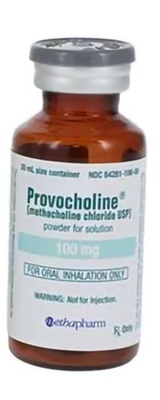
Provocholine® Powder
Methacholine chloride formulation for facilities that prepare testing solutions on-site.
- On-site preparation
- Flexible dilution protocols
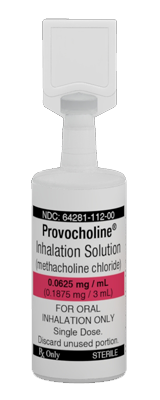
Provocholine® Ready-to-Use Solution
Designed to simplify methacholine challenge testing by eliminating preparation steps.
- No mixing, no wait time
- Room temperature storage
- Colour-coded concentrations avoid errors
- Single-patient kit
- Sterile
- Dosing protocol recommended in ATS/ERS guidelines (quadrupling)
Providers
Use Provocholine® as part of a methacholine challenge test to support the evaluation of patients with suspected asthma.
Labs
Two formulations to fit your workflow, whether you prepare solution n-house or prefer our ready-to-use option.
Patients
Learn what a methacholine challenge test is, why your doctor recommended it and what to expect.
Healthcare Providers

Methacholine challenge testing is used when clinical history and spirometry alone are not sufficient to confirm or exclude asthma. This section outlines where Provocholine® fits within diagnostic decision-making.
When methacholine challenge testing is appropriate
Patient has normal or near-normal spirometry results
Asthma is suspected but not confirmed
Objective evidence of airway hyperresponsiveness is required before a long-term treatment decision
Clinical Benefits
Rule-out confidence
A negative MCT can rule out current asthma when symptoms are current or experienced recently.
Supporting Evidence
Methacholine challenge testing is highly sensitive for current asthma when symptoms are present or recent A negative test can help exclude current asthma as the cause of symptoms (particularly in patients who are not receiving ICS-containing treatment), supporting greater confidence when clinicians are considering whether asthma remains active or is the correct diagnosis.
Reference
Satia I, Inman M, Davis BE. Methacholine Challenge: Physiology, Methodology, and Clinical Interpretation. Clin Chest Med. 2025;46(3):437-452.
Diagnostic support
Helps determine whether asthma-like symptoms are associated with airway hyperresponsiveness, supporting a more objective assessment when baseline testing is inconclusive.
Supporting Evidence
GINA emphasizes that asthma diagnosis should be supported by objective evidence of variable airflow limitation or airway hyperresponsiveness, particularly when symptoms and baseline spirometry are inconclusive. Bronchial challenge testing can provide diagnostic support by documenting airway hyperresponsiveness in patients with asthma-like symptoms.
Reference
Global Initiative for Asthma. Global Strategy for Asthma Management and Prevention, 2025. Updated May 2025. Available from: www.ginasthma.org.
AHR assessment
Quantifies the level of airway hyperresponsiveness to help inform clinical interpretation.
Supporting Evidence
Methacholine challenge testing directly assesses airway hyperresponsiveness, a cardinal physiologic feature of asthma. The degree of responsiveness can help clinicians interpret whether airway reactivity is present and how strongly it supports asthma in the context of the patient’s symptoms and other objective findings.
Reference
Satia I, Inman M, Davis BE. Methacholine Challenge: Physiology, Methodology, and Clinical Interpretation. Clin Chest Med. 2025;46(3):437-452.
Differential diagnosis
Supports evaluation of patients with suspected occupational asthma, exercise-induced respiratory symptoms, or severe asthma mimics such as laryngeal dysfunction.
Supporting Evidence
Reassessment studies show that asthma-like symptoms are not always due to active asthma. In Aaron et al., current asthma was excluded in approximately one-third of adults with physician-diagnosed asthma after objective reassessment, underscoring the importance of considering alternative diagnoses when objective findings do not support active asthma.
Reference
Aaron SD, Vandemheen KL, FitzGerald JM, et al. Reevaluation of diagnosis in adults with physician-diagnosed asthma. JAMA. 2017;317(3):269-279.
Treatment decisions
Helps clinicians avoid overtreatment when asthma is misdiagnosed or no longer active.
Supporting Evidence
Objective reassessment can help prevent unnecessary treatment escalation when asthma is misdiagnosed or no longer active. Aaron et al. demonstrated that asthma medications could be safely tapered and discontinued in selected adults after current asthma was ruled out through structured objective testing and follow-up. In addition, published recommendations addressing SABA overuse emphasize the need for more appropriate asthma management strategies rather than relying on reliever-driven care patterns.
Reference
Aaron SD, Vandemheen KL, FitzGerald JM, et al. Reevaluation of diagnosis in adults with physician-diagnosed asthma. JAMA. 2017;317(3):269-279.
Canonica GW, Paggiaro P, Blasi F, et al. Manifesto on the overuse of SABA in the management of asthma: new approaches and new strategies. Ther Adv Respir Dis. 2021;15.
Objective physiologic information
Measures airway responsiveness that symptoms, spirometry, and FeNO may not fully capture.
Supporting Evidence
Symptoms, spirometry, and inflammatory biomarkers may not fully reflect the underlying physiology of asthma. Evidence describing the heterogeneity of eosinophilic inflammation supports a broader assessment approach, where direct measurement of airway responsiveness can help clarify disease activity beyond inflammatory status alone.
Reference
M. Lommatzsch, et al. Eosinophils in asthma phenotypes: perpetrators or guilty by association? Lancet Respir Med. 2025.
Phenotype support
Helps identify patients whose symptoms may not be driven by Type 2 inflammation alone.
Supporting Evidence
Asthma is heterogeneous, with different phenotypes and endotypes contributing to variable clinical presentation, disease severity, and treatment response. This supports using airway responsiveness alongside biomarkers, clinical presentation, exacerbation history, and symptom onset to better characterize phenotype for diagnostic purposes and personalize management.
Reference
P.J. McDowell, L.G. Heaney. Different endotypes and phenotypes drive the heterogeneity in severe asthma. Allergy. 2020;75(2):302-310.
Forward-looking or investigational applications of airway responsiveness assessment
The clinical benefits described in this section include forward-looking or investigational applications of airway responsiveness assessment with the methacholine challenge test. These applications are not approved uses of Provocholine, which is indicated only for diagnosis in patients who do not have clinically apparent asthma.
Guides therapy and monitors disease activity
Research has explored whether serially tracking airway hyperresponsiveness could add information to standard asthma monitoring, but this is not an approved use of Provocholine, which is indicated only for diagnosis in patients who do not have clinically apparent asthma.
Supporting Evidence
In the AMPUL study, adding airway hyperresponsiveness assessment to asthma management provided clinically meaningful information beyond symptoms and lung function alone. Patients managed with this approach experienced fewer mild exacerbations, greater improvement in FEV₁, and favorable changes in airway inflammation and remodeling, supporting the role of AHR as an objective marker of disease activity over time.
Reference
J.K. Sont, L.N.A. Willems, E.H. Bel, et al.; AMPUL Study Group. Clinical control and histopathologic outcome of asthma when using airway hyperresponsiveness as an additional guide to long-term treatment. Am J Respir Crit Care Med. 1999;159(4):1043-1051.
Long-Term Disease Management Support
Airway hyperresponsiveness has been studied as a potential objective marker that may provide additional context beyond symptoms, spirometry, and biomarkers when assessing asthma over time; however, this application is investigational and is not an approved use of Provocholine.
Supporting Evidence
In the AMPUL study, adding airway hyperresponsiveness assessment to long-term asthma management provided clinically meaningful information beyond symptoms and lung function alone. Patients managed with this approach experienced 1.8× fewer mild asthma exacerbations, greater improvement in FEV₁, reduced airway inflammation and airway remodeling, and improved long-term asthma control.
Reference
J.K. Sont, L.N.A. Willems, E.H. Bel, et al.; AMPUL Study Group. Clinical control and histopathologic outcome of asthma when using airway hyperresponsiveness as an additional guide to long-term treatment. Am J Respir Crit Care Med. 1999;159(4):1043-1051.
Treatment decisions
Helps clinicians avoid overtreatment when asthma is misdiagnosed or no longer active.
Supporting Evidence
Objective reassessment can help prevent unnecessary treatment escalation when asthma is misdiagnosed or no longer active. Aaron et al. demonstrated that asthma medications could be safely tapered and discontinued in selected adults after current asthma was ruled out through structured objective testing and follow-up. In addition, published recommendations addressing SABA overuse emphasize the need for more appropriate asthma management strategies rather than relying on reliever-driven care patterns.
Reference
Aaron SD, Vandemheen KL, FitzGerald JM, et al. Reevaluation of diagnosis in adults with physician-diagnosed asthma. JAMA. 2017;317(3):269-279.
Canonica GW, Paggiaro P, Blasi F, et al. Manifesto on the overuse of SABA in the management of asthma: new approaches and new strategies. Ther Adv Respir Dis. 2021;15.
WARNING: SEVERE BRONCHOCONSTRICTION
Severe bronchoconstriction can result from Provocholine administration (including the lowest dose). The use of Provocholine is contraindicated in pediatric and adult patients with baseline FEV1 < 60% predicted or adults with FEV1 < 1.5 L. Because of the potential for severe bronchoconstriction, the use of Provocholine in patients with clinically apparent asthma or wheezing is not recommended [see Warnings and Precautions]. Emergency equipment and medication should be immediately available to treat acute respiratory distress. If severe bronchoconstriction occurs, reverse immediately with a rapid-acting inhaled bronchodilator agent (β-agonist) [see Warnings and Precautions]. If baseline spirometry is not performed or is measured inaccurately, the initial FEV1 may be underestimated. In this situation, decreases in FEV1 may not be detected after administration of escalating Provocholine doses, which may result in administration of unnecessary higher doses and an increased risk for excessive bronchoconstriction [see Warnings and Precautions – Section 5 of the Prescribing Information].
Laboratories
Whether you're an established pulmonary function lab or expanding your respiratory testing services, Provocholine® offers formulation options designed to support efficient, standardized methacholine challenge testing.
| Feature | Powder | Ready-to-Use Solution |
|---|---|---|
| Preparation | Requires reconstitution | Ready to use |
| Mixing | Required | None |
| Storage | Standard storage | Room temperature |
| Concentrations | Prepared on site | Pre-measured |
| Workflow | Traditional | Streamlined |
Operational Advantages
Expand Testing Capacity
The ready-to-use solution can help laboratories accommodate increased testing volumes by reducing preparation time and simplifying workflow.
Test on Your Schedule
Ready-to-use solution eliminates mixing protocols, making it easier to perform methacholine challenge testing whenever patients are scheduled.
Reduce Preparation Errors
Pre-measured, ready-to-use concentrations help reduce manual preparation steps and the potential for mixing errors, supporting more consistent workflows.
Support More Patients
Simplified preparation can help laboratories improve efficiency, allowing staff to focus on patient care and increasing testing capacity as demand grows.
Downloads
For Healthcare Providers
Provo Leave Behind
For Laboratories
Product Information
Mixing Instructions videos
ATS Short Dilution Video
ATS Long Dilution Video
Frequently Asked Questions
What is Provocholine® (methacholine chloride)?
Provocholine® (methacholine chloride) is a diagnostic bronchoconstrictor used as part of a methacholine challenge test to help evaluate airway hyperresponsiveness in patients 5 years of age and older. It works by causing a temporary, controlled narrowing of the airways in individuals with sensitive lungs, assisting clinicians in the objective evaluation of asthma. Provocholine® is available in both a traditional powder formulation for on-site reconstitution and a ready-to-use solution to support diverse clinical workflows.
What is a methacholine challenge test (MCT)?
A methacholine challenge test is an inhaled diagnostic procedure designed to evaluate airway hyperresponsiveness—a hallmark physiologic feature of asthma. During the test, a patient inhales gradually increasing, controlled doses of methacholine while baseline lung function (FEV₁) is measured under direct clinical supervision. It provides objective evidence to help confirm or rule out active asthma when routine baseline spirometry is normal or inconclusive.
When is a methacholine challenge test recommended over routine spirometry?
Methacholine challenge testing is recommended when a patient experiences persistent, unexplained asthma-like symptoms (such as cough, wheezing, or shortness of breath) but exhibits normal or near-normal baseline spirometry. Because asthma symptoms can be intermittent, standard spirometry may appear normal outside an active flare-up. A challenge test is also utilized to confirm a diagnosis before initiating long-term therapy, rule out active asthma, or evaluate occupational and exercise-induced symptoms.
What is the difference between Provocholine® powder and ready-to-use solution?
Both formulations contain methacholine chloride and deliver equivalent diagnostic performance, but they cater to different operational workflows:
- Provocholine® Powder: The formulation requiring reconstitution and manual dilution on-site, offering flexibility for facilities accustomed to preparing their own testing concentrations.
- Provocholine® Ready-to-Use Solution: A pre-mixed, sterile solution that eliminates compounding steps, mixing wait times, and manual calculation errors. It features color-coded concentrations, room-temperature storage, and supports quadrupling dosing protocols recommended in ATS/ERS guidelines.
Can Provocholine® be used in pediatric patients or children?
Yes. Provocholine® is FDA and Health Canada-approved for use as part of a methacholine challenge test in pediatric patients 5 years of age and older under direct clinical supervision by trained healthcare professionals.
How long does a methacholine challenge test take to complete?
A standard methacholine challenge test typically takes approximately 30 to 45 minutes from baseline preparation to post-test monitoring. The duration depends on the specific dosing protocol used (e.g., standard vs. quadrupling protocol) and how quickly lung function responds. If a positive reaction occurs, a bronchodilator (such as albuterol) is administered immediately, reversing any temporary airway narrowing within minutes before the patient leaves the clinic.
Contact Us
References
- Satia I, Inman M, Davis BE. Methacholine Challenge: Physiology, Methodology, and Clinical Interpretation. Clin Chest Med. 2025;46(3):437–452.
- Global Initiative for Asthma (GINA). Global Strategy for Asthma Management and Prevention, 2025. Updated May 2025. Available from: www.ginasthma.org.
- Aaron SD, Vandemheen KL, FitzGerald JM, et al. Reevaluation of diagnosis in adults with physician-diagnosed asthma. JAMA. 2017;317(3):269–279.
- Canonica GW, Paggiaro P, Blasi F, et al. Manifesto on the overuse of SABA in the management of asthma: new approaches and new strategies. Ther Adv Respir Dis. 2021;15.
- Sont JK, Willems LNA, Bel EH, et al.; AMPUL Study Group. Clinical Control and Histopathologic Outcome of Asthma when Using Airway Hyperresponsiveness as an Additional Guide to Long-Term Treatment. Am J Respir Crit Care Med. 1999;159(4):1043–1051.
- Coates AL, Wanger J, Cockcroft DW, et al. ERS technical standard on bronchial challenge testing: general considerations and performance of methacholine challenge tests. Eur Respir J. 2017;49(5):1601526.